
The Easier It Gets to Add a Line, the Harder It Gets to Count Them
By Bill Henrichs
Founder & President, Bearstone LLC | Former Head of Telecommunications, Simon Property Group
For thirty years, enterprise mobile carried a built-in inventory checkpoint that nobody designed and nobody thanked: the SIM card. A line of service required an object. Somebody ordered it, somebody received it, somebody walked it to a device. The friction was irritating — and the friction was also a checkpoint. Between “a line can exist” and “a line is billing,” there stood a physical artifact with a paper trail behind it.
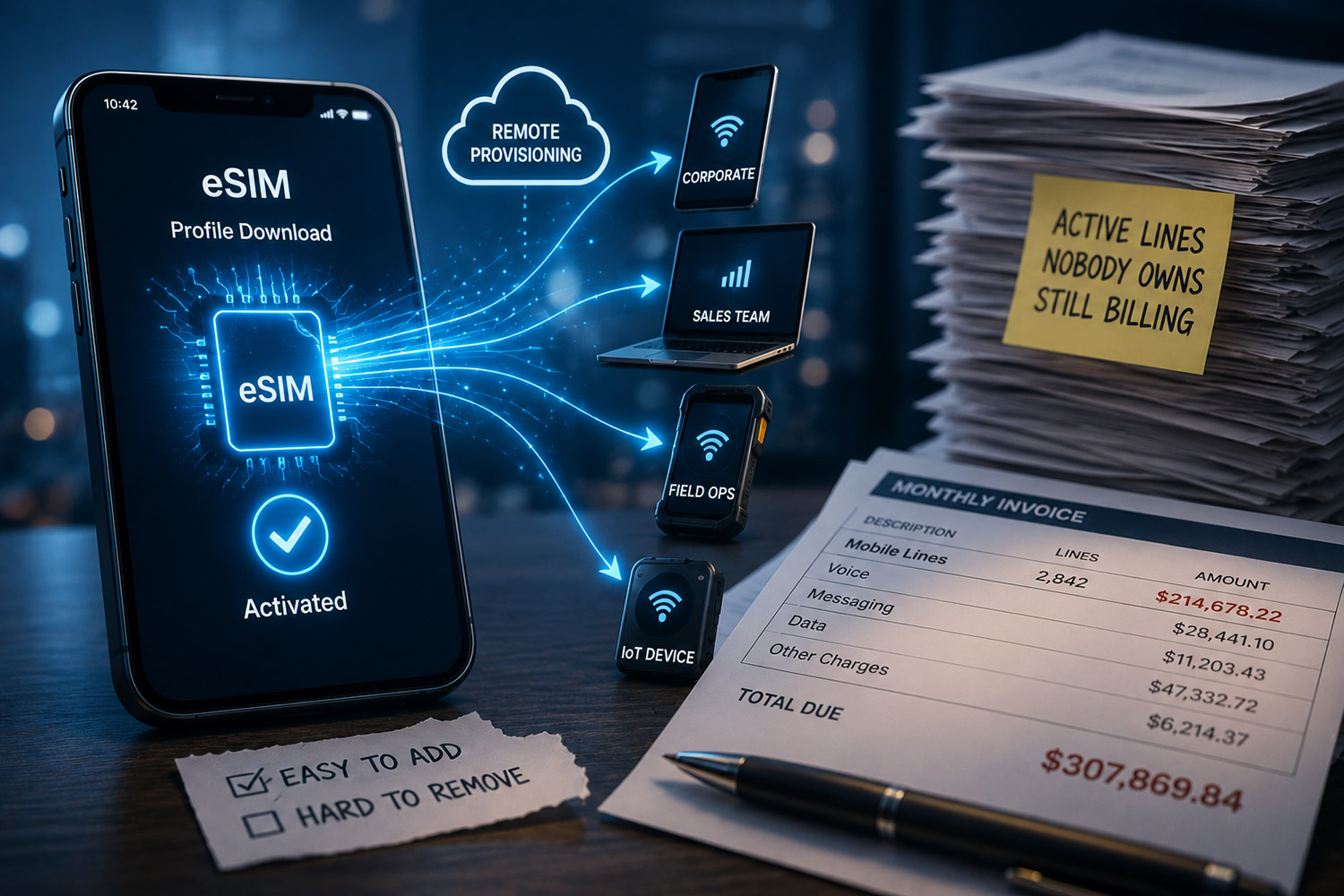
eSIM removes the object. That is the feature, and it is a genuine one. A profile downloads in seconds. A device can hold several at once. The industry’s newest standards exist specifically so a server can push profiles to hundreds of devices in a single action — no tray, no envelope, no technician with a paperclip. Juniper Research expects eSIM connections to pass 1.5 billion devices this year. Nothing here is a complaint about the technology. The technology is better.
What vanished with the plastic is the last moment when adding a billable line cost anyone any effort. And in an ungoverned estate, effort is the only thing that ever slowed the count down. Adding a line is now a tap — provisioning is the half of the lifecycle carriers and device makers have spent a decade perfecting. Retiring a line is still what it always was: a request, a confirmation, a closing invoice someone has to actually read. eSIM made addition frictionless and left subtraction manual. When those two forces are mismatched, an estate moves in only one direction.
Watch where the lines pile up. The employee who left in March — device wiped the same week, line still active in August because nobody’s offboarding checklist owns cellular. The regional profile added for a two-week trip, now in month eleven. The IoT rollout that pushed connectivity
to five hundred sensors in an afternoon — an afternoon that created five hundred new billable lines against one purchase order that nobody has reconciled since. None of these lines announces itself. Each one carries its per-line charges quietly, and together they lean on the pooled-plan math: the committed line count creeps up, the pool tier ratchets with it, and the estate pays a growing price for connectivity that a shrinking share of it is using.
Now the uncomfortable part. If you needed the real number of active mobile lines in your estate today, where would it come from? In most enterprises, the honest answer is: off the carrier’s invoice. That is the quiet inversion eSIM has accelerated. When internal inventory cannot keep pace with software-speed provisioning, the vendor’s bill becomes the inventory of record by default — a count of what you owe, maintained by the party you owe it to.
The answer is not to slow provisioning down. Fast provisioning is why the estate works. The answer is to rebuild the checkpoint on the money side, where it belongs: an inventory of record kept independently of the carrier, and every invoice validated line-by-item against that inventory and the contracted terms — line by line, is this charge attached to a device we can name, at a rate the contract authorizes? — with every variance disputed inside the dispute window, while the contract still obligates the carrier to answer for it. That is the discipline we run as BearGuard, our managed governance process, and mobile is where it earns its keep one modest per-line charge at a time. Across a multi-brand retail portfolio, thirty-one months of that line-by-item validation identified $2,122,436 in unauthorized charges — most of them individually small, none of them individually alarming, all of them real.
The SIM card is not coming back, and it shouldn’t. But the checkpoint it accidentally provided has to be rebuilt deliberately, because an inventory produced by the party that bills against it is not an inventory. It is an invoice. Someone on your side of the table has to keep the real one.